SPG
D-04active

Custom Ops Tooling & Rebuilds

6-9 months and a full dev team -> one 2-week sprint.

custom code / app fabricationcompress timelines while preserving datadatabase-level security (RLS)assess-clean-test-deliver on existing code
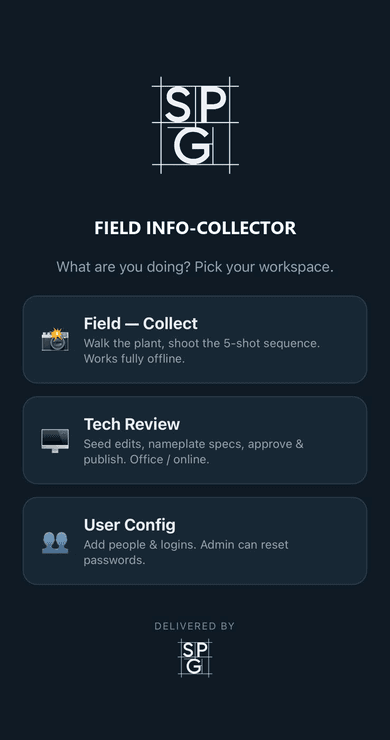
Field Info-Collector front page on a phone: Field Collect, Tech Review and User Config workspacessynthetic demo · Field Info-Collector
The offer
Build Sprint
$20K · 2 wk

Your clunky workflow rebuilt bespoke, data preserved.

Start with the $4,500 Teardown →
The offer
Cleanup Assessment
scoped

Assess, evaluate, recommend, sandbox, deliver.

Start with the $4,500 Teardown →
Proof

What shipped

Rebuilding a broken field system in 3 days

Take a fragile, insecure system and ship a production replacement - fast.

Situation
A field/admin workflow ran on a no-code platform with no real database-level access control, performance collapsing under 1M+ requests/day, and 5-15 hours of manual cleanup per report.
Built
A production admin app on a modern Postgres backend: full CRUD across six entity types, bulk CSV import, in-app user/role management, and true per-site row-level security enforced at the database.
Outcome
Shipped in 3 calendar days (171 modules, clean build, zero errors); per-site access proven across three user roles by direct database-impersonation testing. Infrastructure cost path dropped from ~$5-7K/yr to ~$1.2K/yr.
3 calendar days171 modulesper-site RLS proven across 3 roles$5-7K/yr to $1.2K/yr

Security you can prove, not assert

Enforce access control where it actually holds - the database.

Situation
The old system's security was the UI hiding buttons; the data underneath was open to direct access.
Built
Row-level security tied to per-site membership and role, plus DB-owned audit stamping that can't be faked at the app layer.
Outcome
A field tech cannot read another site's data no matter what they do. Verified by impersonation testing, not claimed.
per-site RLSDB-owned audit trailzero false-access leaks in testing

Fix what's there, when a rebuild is overkill

Know when to clean up existing code instead of replacing it - and prove it before shipping.

Situation
Not every clunky system needs a ground-up rebuild; sometimes the existing code just needs to be understood and repaired.
Built
A disciplined path: assess the existing system, evaluate what's salvageable, make recommendations, prove the fix in a sandbox, then deliver.
Outcome
The client gets the cheapest correct answer - cleanup when cleanup works, rebuild when it doesn't - tested before it lands.
assess -> evaluate -> recommend -> sandbox/test -> deliver

← all departments